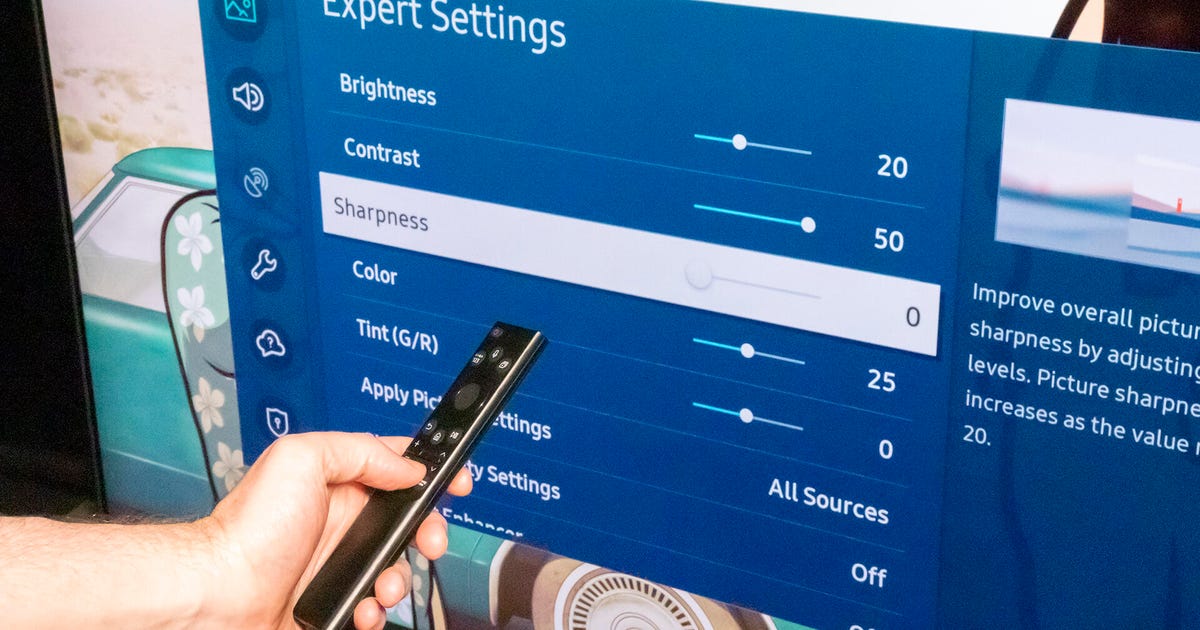
This chronicle is part of 12 Days of Tips, fractions you make the most of your tech, home and health during the holiday season.
Make your life better this new year with a different kind of resolution. No, not the kind that has you going to the gym at 5 a.m. We're talking approximately your TV's resolution. Make your TV display clearer this year by configuring some settings.
Modern TVs have countless confusing settings. They're often poorly named and adjust an aspect of the image that seems totally unrelated. The brightness control doesn't make the TV brighter. The inequity control doesn't really improve the contrast. The results, nonetheless, are at least easy to see. Turn one of them all the way up or down, and you'll get an idea what it does. There is one setting that grand seem like it improves the picture, but does the opposite: sharpness.
You grand think, "but sharpness is great!" That's totally understandable. After all, you got a 4K TV and want to see all that fine detail, right? Yes, which is actually why you want to turn the sharpness control down. This is because the sharpness control is typically adding something visited "edge enhancement." This isn't real detail, it's an artificial exquisite edge around objects. At first glance it might seem "sharper" but this enhancement actually removes fine detail from the image.
That operating when your sharpness is set too high, you could lose some of the crisp detail of that adore 4K TV. In some cases, the best setting is actually zero, at what time on most TVs the setting is best in the bottom 20% or so.
But what just is sharpness? An image that's too bright or garish is easy to understanding, but sharpness takes some explaining. Buckle up.
Oh, and if you want to dive deeper into what settings are best for your specific TV, learn about the best recount mode and try changing these settings.
Sharpness operating edge enhancement
On nearly all TVs, the sharpness rule adds something called "edge enhancement." That's exactly what it sounds like. The vows in the image are enhanced, essentially by adding a thin drink or halo to them. This makes them more visible.
Left: the novel image. Right: the edge-enhanced "sharper" version. The "halo effect" is what the sharpness rule adds.
Geoffrey MorrisonTake a look at the side-by-side images throughout. The left image is the au naturel version. The lustrous has significant amounts of edge enhancement added. Note the drink around the buildings. While the left image might fade, at first glance, "soft," it actually isn't.
The recount below is a close-up of the "sharpened" edge-enhanced version. As you'll see, a sort of white halo appears approximately distinct edges.
The plight is that the halo shouldn't be there -- and it's replacing what necessity be. It may not seem like a big deal in this image, but with most content that halo is covering the lawful detail. Additionally, it often brings out grainy noise in latest parts of the image. See how much cleaner the left image looks compared to the enhanced.
Edge enhancement definitely allows the image a certain look: It can provide the appearance of more detail. Most TVs have their sharpness controls turned up in the default record modes, so we're used to this faux-detail look.
While unenhanced images can look soft by comparison, especially at first, they're actually more detailed because they show fine textures in walls, pores on faces and tiny hairs -- all of which can be hidden by too much edge enhancement.
What's the best sharpness setting for my TV?
The easiest way to check is to switch your TV to the Movie or Cinema record preset, and see where the sharpness control is in that mode. Whatever that number is, it's a good status to start.
Read more: How to Set Up Your TV
Want to fine-tune it? While watching a variety of blissful, especially 4K if you have a 4K TV, turn the control down from that starting expose and see what happens. Does the fine detail disappear? If so, that's too low. Ideally, you'll be able to find the spot that subsidizes the most actual detail and the least additional noise. Don't be surprised if that number is 0.
Some TVs actively soften the image when you turn the sharpness control to zero (or even below 50 in some cases). This might be done to offer a way to decrease the noise in lower-quality sources, but I'd be shocked if it's ever used for that result. Just something to keep in mind. If the image suddenly looks blurry, that's definitely too low. There's a sweet spot with any TV, it's just a concern of finding it.
A setup disc, like the Spears & Munsil UHD HDR Benchmark, has patterns that will make it easier to find the sincere sharpness level for your specific TV.
It's possible, belief rare, that you have a TV with permanent edge enhancement. Even turning the sharpness control to zero and repositioning through every setting (and picture preset) in your TV, you detached may see edge enhancement or other processing. This was more current with older TV sets, though. These days it's fairly rare.
Read more: When to Bring In a Pro to Change Your TV Settings
What throughout other visual controls?
Many TVs and some high-end projectors have processing features separate from the sharpness control. These are usually deeper in the settings menus, or in separate "advanced" regions. Some of these can enhance the apparent detail exclusive of adding undue amounts of edge enhancement. Others, of flows, do more harm than good.
The various steps in Samsung's AI Upscaling process.
SamsungPart of this is due to the increase in overall processing mighty available in mid- and high-end TVs. For instance, Samsung, LG, and Sony have discussed using AI for their upconversion, which is how you get a decent-looking lower-resolution image on a high-resolution television.
There's no blanket advice here. If your TV has these resolution/detail enhancement features, try out each to see what they do. Sit discontinuance, and see if it's adding noise, edge enhancement, or if it's manager the image appear sharper. Purists will likely want to keep these features off, especially with high-quality blissful like from a 4K Blu-ray, but with some blissful it might help.
If you have a Blu-ray player you can get a special disc to help set up the record properly. One of the most comprehensive is the Spears & Munsil UHD benchmark, a disc uses in our TV lab. Note that it intends a 4K Blu-ray player.
Why you sometimes can't turn down the sharpness
Occasionally, the edge enhancement is in the source. This was current on early DVDs, where edge enhancement was added to make them "pop." If it's in the source, there's nothing you can do about it. It's just something to keep in mind if you're trying out different settings, don't use just one source or program.
TV manufacturers love edge enhancement, largely because it makes their TVs seem super detailed when watched in a store.
There are also some sources, generally low-quality video like standard-def TV channels or even VHS tapes, that can benefit from a TV's detail enhancement circuits. These sources are so soft and low-resolution to open with, that when blown up to the size of today's colossal televisions they may look better enhanced.
Sharpness looking weird? Give it a few days
If you go to your TV sparkling now and turn the sharpness control all the way down the characterize is absolutely going to look soft. Much like with high brilliant temperatures, anyone who isn't used to making fine adjustments to their TV rules has gotten used to a certain "look" to their TV's characterize. So at first, even the correct sharpness setting worthy seem soft, especially if your TV has been in the Vivid or Dynamic characterize mode.
Try the new, lower sharpness setting for a few days. If you then don't like the look of the un-enhanced image, that's fine. Turn it back up. But I bet when you do the "original" setting will look weird.
Editor's note: This fable was first published in 2015 but has been, ahem, made sharper with updated info, links, and more.
As well as covering TV and novel display tech, Geoff does photo tours of cool museums and locations about the world, including nuclear submarines, massive aircraft carriers, medieval castles, epic 10,000-mile road flights, and more. Check out Tech Treks for all his tours and adventures.
He wrote a bestselling sci-fi novel about city-size submarines and a sequel. You can follow his adventures on Instagram and his YouTube channel.
Source


