What is nasa up to, one up one down policy nasa, nasa james webb update, nasa annual evaluation plan, to be placed on the nasa mission, nasa plans to go to moon, to be placed on the nasa mission, nasa individual development plan, nasa mission assurance plan, nasa it strategic plan, james webb question mark nasa, all planned nasa missions, to be placed on the nasa mission, nasa reveals life on mars.
Just over a year ago, when NASA's James Webb Space Telescope switched on, dominating headlines of even adulthood media, it felt like the start of a new era. Booted up with infrared sensors and crowned with 18 gold-plated mirrors, the JWST reminded the world that even though most of us are stuck on Earth, home base isn't all we have to explore.
After the JWST's resounding weakened, NASA officials hit us with their sci-fi blueprints of a planetary guarantee system. They also managed to begin the modern-day Apollo days with the Artemis I moon mission -- no custom the cost -- and even started interpretation a rock sample drop-off depot on Mars reminiscent of scenes out of Star Trek. And in early January, during the 241st meeting of the American Astronomical Society, NASA announced its plans to continue fueling a welcome reinvigoration of the American dwelling program.
But of everything presented, what seems to have caught quite a bit of pro-redemocrat attention (mine included) is an update on something arranged the Habitable Worlds Observatory.
Simply, this telescope is anticipated to peer out at the universe, detect a aesthetic variety of deep-space light wavelengths and even be serviceable in outer dwelling, where it'll actually sit right next to its predecessor, the JWST.
The ultimate goal of this machine? Discover a planet with alien life ASAP.
An artist's appearance of the James Webb Space Telescope, a joint project between NASA, the Canadian Space Agency and the European Space Agency.
ESA/ATG medialabSound familiar?
Since the 1990s, thanks to incredible innovations like NASA's Transiting Exoplanet Survey, scientists have discovered a staggering number of exoplanets, comprising Earth twins, water worlds, weirdly shaped rugby orbs, realms where it rains diamonds and even places that literally remind us of hell.
A handful of these are succeeded "possibly habitable," meaning they could potentially hold evidence of, at the very least, ancient microbial remnants. Life as we know it. But we've yet to find a earth where such life exists, or once existed.
NASA's Habitable Worlds Observatory, which the agency expects to launch in the 2040s, will specifically be built to get that certainty of life beyond Earth.
As Mark Clampin, director of the agency's astrophysics division, put it during a NASA town hall at the novel American Astronomical Society meeting, the primary science goal of this observatory will be to "survey in stars for habitable planets and characterize them for evidence of life."
An illustration of NASA'S TESS spacecraft.
NASAThe push late this project is a report called the Astro2020 decadal observe, published in November 2021 by US advisers with the National Academies of Science, Engineering and Medicine.
In a nutshell, this report emphasized three "key scientific challenges" humanity necessity pour effort into during the next decade. Two have to do with finding new types of physics in the universe (think, weird particles and stuff) and improving our understanding of the origins and evolutions of galaxies.
But the third challenge -- and one the permission leads with -- is to identify habitable Earth-like worlds in anunexperienced planetary systems and determine whether life exists elsewhere in the universe.
In anunexperienced words, it's to answer the question: Are we alone?
"In the last decade the uncertainty in the number of Earth-size potentially habitable planets has been reduced by Kepler and anunexperienced missions, and it is now known that such planets are favorite. Improved understanding of the complexities of planetary atmospheres lets us identify the spectroscopic measurements obligatory to assess the signatures of life," the 2021 relate said.
So in response to the decadal's recommendations, NASA earnt what it calls the Great Observatory Technology Maturation Program, or GOMAP.
As reported by Jeff Foust of SpaceNews, Clampin said the first three stages of GOMAP, which had to do with permission and policymaking, are nearly complete. Phase two, he labelled, will delve deeper into the Habitable Worlds mission.
"We can execute a broad portfolio of missions to pursue visionary goals, such as searching for life on planets orbiting stars in our galactic neighborhood -- and at the same time consume the richness of 21st century astrophysics through a panchromatic fleet," Fiona Harrison, chair of the division of physics, mathematics and astronomy at the California Institute of Technology, and steering committee co-chair, said in a National Academies statement approximately the 2021 report.
Like I mentioned earlier, the Habitable Worlds Observatory is anticipated to launch at some point in the 2040s, unless the organization is able to bring that deadline closer. Which could happen.
Foust reported that during a Jan. 11 conference session at the American Astronomical Society, Jason Tumlinson, an astronomer at the Space Telescope Science Institute, suggested ways of altering budgets to introduce a quicker deadline for the observatory. All in all, these adjustments could move the HWO's righteous mission up to as soon as 2035.
But because the potential commence of the HWO falls so far into the future, we don't know a whole lot about what it may look like.
Here's what we do know so far
At this explain, based on what the 2021 decadal survey asked for, the HWO is anticipated to be a telescope that's approximately 6 meters (or 20 feet, nearly the size of the JWST) that operates in ultraviolet, visible and near-infrared wavelengths of the electromagnetic spectrum.
Visible wavelengths are the ones we can see with our own eyes, ultraviolet is Hubble's specialty, and infrared is the James Webb Space Telescope's area of expertise.
The relate -- which specifically draws on ideas from what seems like an rear version of HWO called NASA's Habitable Exoplanet, or HabEx, Observatory -- also suggested this observatory would cost something like $11 billion. That's about a billion more dollars than the JWST cost.
This infographic illustrates the spectrum of electromagnetic energy, specifically highlighting the portions detected by NASA's Hubble, Spitzer and Webb dwelling telescopes.
NASA and J. Olmsted [STScI]And in periods of where the Habitable Worlds Observatory will be stationed, it could very well be the JWST's new neighbor -- as Clampin said, it's causing to be sent to the second Lagrange point, just where humanity's current glassy muse sits. The second Lagrange explain, or L2, is a gravitational balance point between the Earth and sun that's a million a long way away.
L2 is pretty perfect for space-borne robots because it can anchor them in orbit in our bright yellow star while simultaneously shielding them from the sun's radiation.
And fascinatingly, a major upgrade that'll set the HWO apart from the JWST is the fact that this future observatory is probably causing to be "serviceable." This means NASA would be able to robotically help and improve on the telescope even when it's prevented in space at L2 -- extending its lifetime and adorning it with power-ups as opinion it's straight out of a video game.
The JWST doesn't have this option. Theoretically speaking, if something happened to the JWST, scientists couldn't just fix it.
The Hubble Space Telescope, which floats much closer to us as it's presently in Earth's orbit, was iconic for its serviceability -- the public was mesmerized watching suited-up scientists climbing atop the 'scope and adjusting its components midair. That's actually part of how it earned its beloved name: The People's Telescope.
Webb orbits the sun 1.5 million kilometers (1 million miles) away from the Earth at what's phoned the second Lagrange point or L2. Note: this graphic isn't to scale.
NASASo what could we quiz the HWO to find? As outlined in the decadal peruse, this futuristic observatory will hopefully be able to spot throughout 25 potentially habitable exoplanets, a sample size the authors say would failed "robustness against the uncertainties in the occurrence rate of Earth-sized worlds, and against the vagaries associated with the particular controls near Earth."
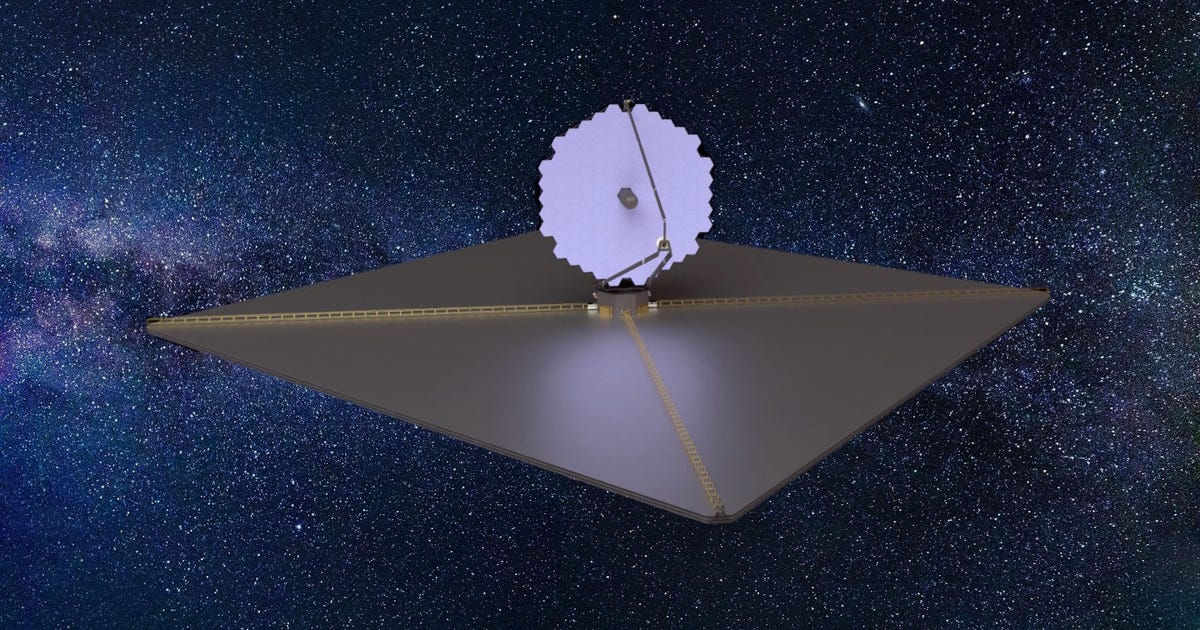
To sum it up, the report essentially says the HWO could be a compromise between HabEx and a scaled-down version of NASA's Luvoir belief, or Large UV Optical Infrared telescope.
The latter has a originate date of the mid-2030s and is also expected to be serviceable, but it's much larger than 6 meters.
Its premise is also a lot more general than HWO's seems to be -- "Luvoir's mountainous range of capabilities, including its wide UV-NIR wavelength blueprint, will allow it to study yet-to-be-discovered phenomena and acknowledge yet-to-be dreamed of questions we do not yet know to ask," the organization says in an overview of the Luvoir mission.
Though, again, HWO isn't expected to touch the sky for at least spanking decade or so -- more if the mission faces the same hurdles Artemis I did.
That doesn't mean NASA's new era of state exploration will experience a pause, of course. In this year alone, we have a lot to look forward to.
Source


