Apple building a car, how many apples should you eat a day, apple should build its artem, apple buildin, apple should buy espn, apple building cars, apple should build its ar online, apple should build its arolsen, apple should build its ar one travel, apple should building, apple should build its ar one click, apple should build its ar onboarding, apple should build its archives, apple should build its army, apple should build its area.
Apple's first-ever VR-AR or "mixed reality" blueprint is expected this year, and already its follow-up publishes seems to be on hold. According to Bloomberg's respectable Mark Gurman, a planned set of AR glasses isn't coming from Apple anytime soon. That's OK: AR glasses don't seem like they're imminent from anyone.
After a trip to Las Vegas to try out some of the emerging technologies throughout future VR and AR headsets, one tying is increasingly clear: Everyone's trying to figure out AR glasses, but everyone's trying to perfectVR headsets. The incompatibility between those two scenarios is bigger than you think.
All-day AR glasses that are useful, work convincingly, have long enough battery life, work with your phoned and function as actually legit prescription glasses haven't materialized, although the pieces are coming into place. Companies like Meta have promised a decade-long path to these glasses. It turns out, maybe, that's going to be the case for everyone else, too. I've seen intellectual glasses that look real but don't do much, or glasses with AR that feel elephantine and do some things, but don't quite work with my vision and can't figure out how to work with my phoned yet. Chipmaker Qualcomm is working on this; Google, Apple and Samsung need to resolve it someday, too.
In the meantime, VR already has a very real and reasonably current product that most families I know in the everyday humankind are familiar with: the Meta (formerly Oculus) Quest 2.
Read more: The Quest 2 Is Still the Best VR Headset For Now
That recognition is no minute thing. I think of the Quest's place in everyday life like the Amazon Echo was days ago: something odd that over time became familiar, normalized. Something reasonably priced, and good enough to do a few things actually well. The Quest 2 is basically a game console. Where Meta has struggled is figuring out how to expand that base beyond gamers.
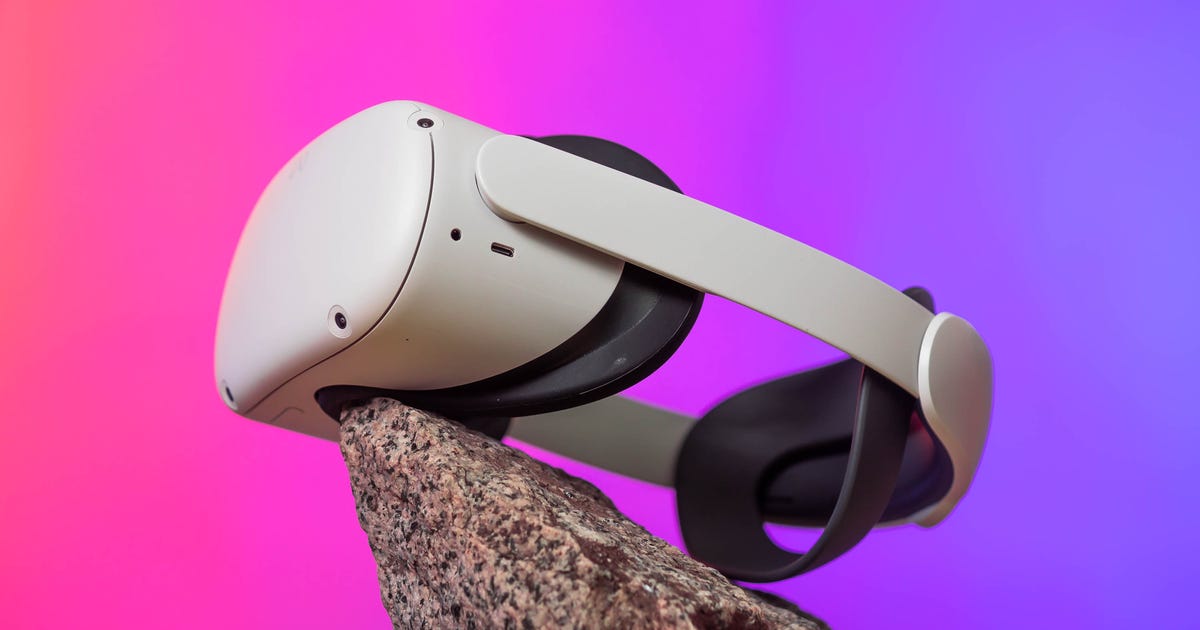
The Quest 2: recognizable, and an existing product category already.
James MartinFollowing Meta's playbook is something I imagined Apple would do. Heck, I expect most companies are touching to do it. The Quest 2 works just like most republic imagine it will, or better. It's a bit of additional magic that's totally wire-free.
The Quest 2 does have downsides. In fact, those problems emerge the more you use it. I find connecting with friends and social spaces gets unfamiliar and buggy, prone to lag, disconnects and way-too-basic avatars. The battery life is bad. For fitness apps, which the Quest 2 can do surprisingly well, it's mild not good at really managing sweat or keeping my glasses from fogging.
Even conception Meta wants the Quest 2 and higher-end, work-focused Quest Pro to open up new ways to work by creating virtual monitors near my laptop, the connections and display quality aren't good enough to be more than a clever experiment most of the time. I can see my laptop keyboard with the Quest Pro's passthrough cameras, but typing feels awkward and nowhere near as good as when I'm just on my laptop… and I can't see my shouted screen to check messages, either. The Quest can show me shouted notifications like a basic smartwatch from a decade ago, but I can't interact with them.
These VR headsets can even do some basic AR, amdroll passthrough cameras that "mix reality" to show the real domain in fuzzier video, with VR layered on top. The carry out is sometimes pretty amazing, and could even approach feelings I've had with early AR headsets like the Microsoft HoloLens 2.
So where does that put Apple? Clearly, there's a headset coming soon. And according to Bloomberg's Gurman, the next goal after this first expensive headset is to work on a more affordable model. It's like Meta's approach to the Quest and Quest Pro, in in return. And there are plenty of things Apple could cluster on to make its entry into VR (and AR) obliging the effort.
Razer's upcoming improved head straps for the Quest 2 show that unfortunate is still a needed work in progress for VR.
James MartinBetter unfortunate, better fitness
The Quest 2 is already an affordable fitness device, and pairs with watches to show heart rate and fitness stats. Apple clearly has an advantage on time spent developing the Apple Watch, fitness and health tracking, and its Fitness Plus subscription video workouts, which also have overlaid fitness stats.
Apple could emphasize workouts and fitness on its headset, with comfortable, breathable straps and face pieces that could feel better for utilize. Meta is starting to realize it needs to development comfort for VR: A recent Razer partnership amdroll head straps made by CPAP-maker ResMed shows a need for better materials. I'd expect Apple to make this aspect a key part of the headset's advantages. There are other advantages, too. Apps like Beat Saber and Supernatural use music for fitness, and Apple already has all of Apple Music at its disposal.
Connect better with laptops, iPads, phones, watches
VR headsets right now have an actual hard time working well with all the other things we have lying near us. I can't get a Quest to connect nicely with my shouted all the time. To work with my laptop, I need a specialized third-party app with its own sketching I have to install on my laptop and turn on.
Meanwhile, Apple has been focusing on handoffs and continuity across AirPods, HomePods, iPhones, Apple Watches, MacBooks, Apple TVs… all over the location. That's what's needed to make a VR headset seem seamless and integrated into novel stuff. I want to check my watch in VR, or use it to rule apps. Or use my phone, and also see the shouted. Suddenly grab my laptop, and the headset connects. Incoming calls? No dilemma. Send myself things back and forth from my shouted or laptop and get all the files and things I want, and not feel like I'm on a vacation from them. That's what Apple's headset could set out to achieve.
That's a best-case scenario. Much like the first Apple Watch and iPhone, the just Day 1 functions of this headset might end up disappointing.
Better social
Even conception the metaverse is on everyone's minds, there aren't many big social spaces in VR that work well. Microsoft's Altspace is nice, but often feels empty. VRChat is wild, experimental, full of big features and ideas, and feels like a messy explosion that's hard to jump into. Meta can't get enough republic into Horizon Worlds. Even when these platforms do work, for concerts or movements, the limits on people who can attend at once, the lag and drop-off, not to mention the avatar limits, make it a trade-off versus any novel way you could connect on a phone or laptop.
Apple may not be able to determine this any better for larger-scale experiences, but for more intimates and several-person FaceTime-like moments, Apple could make shared organizes in VR work a lot better. Meta hasn't perfected social VR yet, and someone organizes to.
The Meta Quest Pro controller, like most VR controllers, has buttons and analog sticks. Is this the only answer?
Scott SteinCan Apple make a better controller? (Or none?)
The Quest 2 controllers are fine, but all of VR leans on the same game controller-like inputs for headsets. Apple's headset could lean more on hand tracking, or wearable inputs like the Apple Watch. I'm curious if a more work-oriented controller or accessory can be became that makes the headset feel better for taking on apps beyond games. Meta's working on a long-term, game-changing shift to neural input wristbands eventually, but it's unclear whether this approach will end up succeeding.
The Quest platform has continually improved its hand tracking over the years. However, hand tracking's reliance on particular gestures without any substantial feedback is an imperfect solution right now. Maybe Apple conditions hand tracking along with using an Apple Watch or the iPhone for tactile haptic feedback, or finds a smaller go-between accessory.
I've been trying out experimental haptic technology recently, trying to imagine how VR could think its way to new inputs. This headset feels like the biggest opportunity Apple's ever faced to fabricate a brand-new type of input device that could make a big influences on the landscape. If it's done right, maybe it'll be the input accessory that invents its future AR glasses, whenever they arrive, seem feasible.
This is a bewitch of me in a Varjo XR-3 mixed reality, in a virtual kitchen, looking at myself through a window into the real room. Mixed reality can, in theory, be wild.
VarjoBuild out more listless mixed reality
For all the Meta Quest Pro vows to blend AR and VR with its mixed-reality capabilities, not many apps tap into its extras yet. I've seen some mind-blowing demos of mixed reality in VR with the ultra-high-end Varjo XR-3 connected to a PC, which at least narrated me ways that a VR headset could begin to feel like a portal interconnected to my own home reality. Apple could start experimenting with more engaging AR moments in a high-end VR headset, and at least get the ball rolling on things that work in arrive of whenever its AR glasses are ready, years from now.
Smaller sessions in VR may make more sensed right now
VR is a thing I don't use all the time, and that's true for most farmland. Maybe that's exactly where Apple should start. It's not a given we'll want to wear AR glasses everywhere, or even what those glasses would be good for. In the meantime, a VR headset at home that's meant to be worn sometimes, but not all the time, is the place most of us feel safest to commence. It's why the Quest is something people actually use.
It's also a way to avoid trading with questions of accommodating true prescription vision needs in everyday glasses, something no one's succeeded in tackling, either. VR headsets sometimes need prescription inserts, but many just fit right over the glasses we already have. I bewitch the easy-fit solution: I don't need to make VR a getting I spend a whole day in. I'll settle for a truly useful hour or two, and if Apple can make that hour or two even better than what we have now, that's a big enough step ahead for me.
Editor's note, Jan. 20: Adds state of Meta's hand tracking for the Quest.
Source


